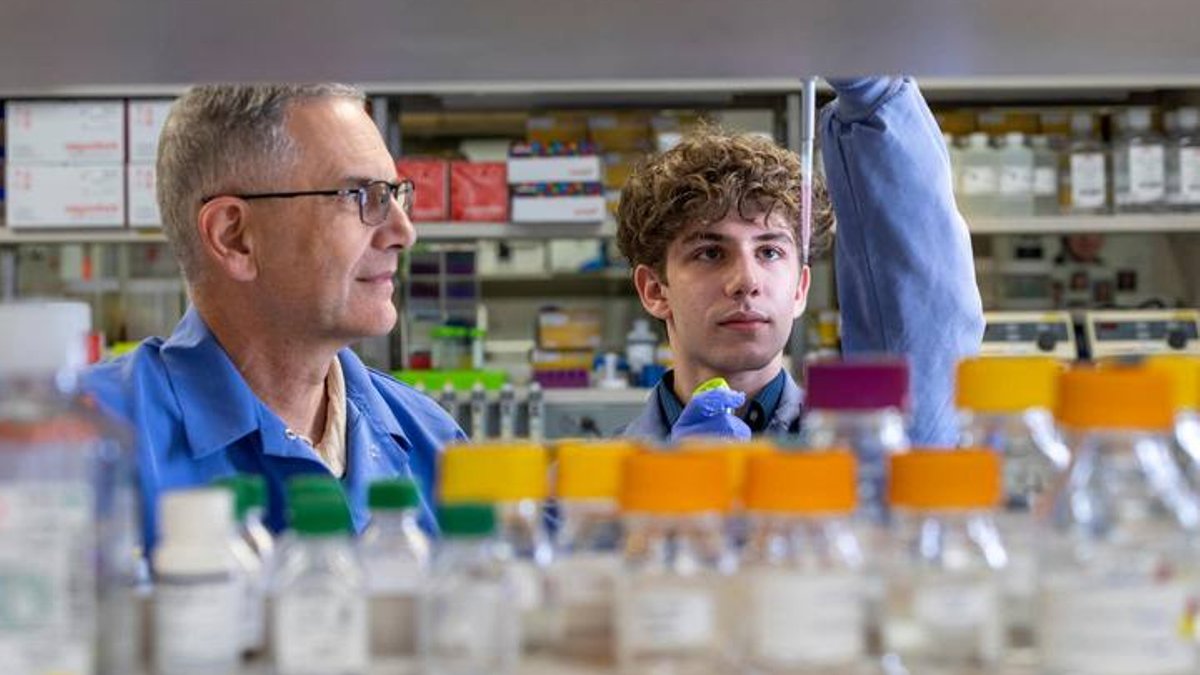
A high school student’s AI-powered cancer research has produced a meaningful discovery at Mayo Clinic, showing how early guidance can speed up scientific progress. Alan Alwakeel, who entered Mayo Clinic’s SPARK program as a junior in 2024, started his project through the initiative, which pairs high school students with physician-scientists in active research labs. Unlike most participants who join existing studies, Alwakeel entered with his own idea: using AI to predict how cancer cells might react to different drug combinations. The challenge he targeted was a long-standing problem in oncology—testing thousands of potential drug pairings in labs is both time-consuming and expensive. His solution proposed using virtual simulations to identify the most promising combinations before moving to real-world testing.
The project drew quick interest. Working under Cui Tao, Ph.D., chair of the Artificial Intelligence and Informatics Research division, Alwakeel developed a computational framework that combined genomic and proteomic data. The system simulates biochemical interactions to determine whether drugs will work together or cancel each other out. After constructing the model, he verified its accuracy through lab experiments, finding strong matches between predictions and observed results.
Dr. John A. Copland III, Ph.D., whose lab handled the validation phase, described Alwakeel’s work as extraordinary. “He’s done more than most people have done through a postdoctoral fellowship,” says Dr. Copland. The team continues to assess how the model could be further developed and applied to support future scientific investigation.
The SPARK program operates with strict expectations. Students are treated as colleagues, not observers, and Alwakeel faced immediate challenges from his mentors. Instead of guiding him through each step, they pushed him to explain and defend his methods. “They didn’t hold my hand through it,” he says. “They encouraged me to do all of the research myself and defend the project.” This approach forced him to grasp advanced concepts in biochemistry and computational modeling independently.
Explaining his findings to seasoned researchers also honed his ability to present complex ideas clearly. By his final year, he had won a second-place Grand Award at the International Science and Engineering Fair, graduated as valedictorian of Stanton College Preparatory School, and earned admission to Harvard University, where he plans to study neuroscience and computer science.
Beyond his academic milestones, the virtual cell model represents an unusual case where a high school student’s work has direct scientific relevance. “AI allows us to test possibilities at a scale that would be impossible in a traditional laboratory,” Alwakeel says. “It helps us focus resources on the solutions most likely to help patients.”